Yamaha vs Roland vs Casio Digital Piano: 2026 Brand Comparison
By FindKeyboard.com · Updated 2026-11-15
Most people shopping for a digital piano end up choosing between three brands: Yamaha, Roland and Casio. Each builds its whole range from a small set of shared parts — a key action, a piano sound engine, a Bluetooth approach and an app — so once you know those, you can predict what any model in the range will give you.
This guide compares the three brands tier by tier (entry portable, step-up portable, home cabinet) using the manufacturers' own spec sheets. We have not played these pianos side by side, so there is no "best feel" ranking here; where we mention how actions or sounds are commonly described, we say so. We also leave prices out on purpose — they change weekly — and link to pages where we checked them.
Short version: choose Roland if key feel and wireless app use matter most — escapement and Bluetooth MIDI start on its cheapest FP model. Choose Yamaha for the familiar Yamaha grand sound, the widest range and the simplest, lightest entry piano. Choose Casio if space, weight or budget lead: it has the lightest body here, runs on batteries, and gives the most polyphony and Bluetooth for the money in its slim Privia line.

Yamaha P-145
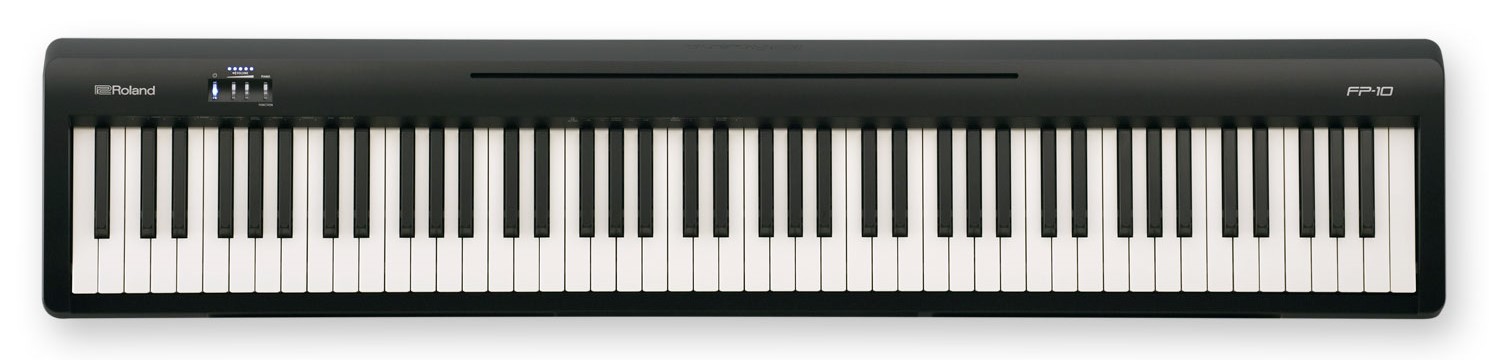
Roland FP-10

Casio PX-S1100
The Three Brands at a Glance
What each brand builds into its current portable 88-key pianos, from official specs. On a phone, swipe the table sideways.
| Yamaha | Roland | Casio | |
|---|---|---|---|
| Entry key action | GHC (Graded Hammer Compact) | PHA-4 Standard (escapement, Ivory Feel) | Scaled Hammer Action Keyboard II |
| Step-up action | GHC on P-225; GH3 on Arius YDP-165 | PHA-4 Standard on FP-30X; PHA-50 on FP-90X | Smart Scaled Hammer Action (PX-S1100); Tri-sensor SHA II (PX-870) |
| Piano sound | Sampled Yamaha grands: CFIIIS (P-145), CFX (P-225, YDP-165) | SuperNATURAL Piano across FP-10/30X/60X; PureAcoustic Modeling on FP-90X | Multi Dimensional Morphing AiR (PX-S1100) |
| Polyphony range | 64 (P-145) → 192 (P-225, YDP-165) | 96 (FP-10) → 256 (FP-30X) | 64 (CDP-S110) → 192 (PX-S1100) → 256 (PX-870) |
| Bluetooth pattern | Audio from P-145BT/P-225 (varies by country); no built-in MIDI | MIDI from FP-10 (varies by country); audio + MIDI from FP-30X | None on CDP-S110; audio + MIDI via included WU-BT10 on PX-S1100 |
| App | Smart Pianist | Roland Piano App | Chordana Play for Piano |
| Lightest 88 here | P-145: 11.1 kg | FP-10: 12.6 kg | CDP-S110: 10.5 kg |
| Stands out for | Familiar grand sound, widest range | Key action and wireless apps from the cheapest model | Slim, light bodies; battery power; specs per dollar |
All models named here have 88 weighted, graded hammer-action keys, built-in speakers, USB to a computer, and a basic pedal or footswitch in the box. Battery power: Casio lists about 13 hours on six AA batteries for the CDP-S110 and about 4 hours for the PX-S1100; the Yamaha and Roland models here run on mains power only.
Brand is only one input. Our AI digital piano finder asks about your budget, room and goals in 3 questions and suggests specific Yamaha, Roland or Casio models, each with a reason it fits.
Tier by Tier: How the Lineups Match Up
Brand comparisons only make sense between pianos at the same level. These are the closest current matchups in each brand's range.
| Tier | Yamaha | Roland | Casio |
|---|---|---|---|
| Entry portable | P-145: GHC, CFIIIS, 64 notes, 7 W × 2, 11.1 kg, no Bluetooth (P-145BT: audio) | FP-10: PHA-4 Standard, SuperNATURAL, 96 notes, 6 W × 2, 12.6 kg, Bluetooth MIDI* | CDP-S110: SHA II, 64 notes, 8 W + 8 W, 10.5 kg, no Bluetooth, battery option |
| Step-up portable | P-225: GHC, CFX, 192 notes, 7 W × 2, 11.5 kg, Bluetooth audio*, AUX OUT | FP-30X: PHA-4 Standard, SuperNATURAL, 256 notes, 11 W × 2, 14.8 kg, Bluetooth audio + MIDI, line outs | PX-S1100: Smart Scaled Hammer Action, AiR, 192 notes, 8 W + 8 W, 11.2 kg, Bluetooth audio + MIDI (WU-BT10 included) |
| Home cabinet (3 pedals) | Arius YDP-165: GH3, CFX, 192 notes, 20 W × 2, 42.0 kg | Not in our spec check this round | PX-870: Tri-sensor SHA II, 256 notes, 20 W × 2, 34.3 kg |
| Top portable we track | — | FP-90X: PHA-50 wood/plastic hybrid, 25 W × 2 + 5 W × 2, 23.6 kg | — |
*Bluetooth on the FP-10 and P-225 may not be included depending on the country of purchase, according to Roland and Yamaha. For the full 12-model spec table, including Kawai and Korg, see our digital piano comparison chart.
Two patterns stand out. At entry level, Roland's FP-10 is the only one of the three whose maker lists escapement and Bluetooth MIDI, while Casio's CDP-S110 is the lightest and the only one that runs on batteries. At the step-up level the brands converge on polyphony (192–256 notes) and Bluetooth, and the differences shift to speakers, outputs and weight: the FP-30X has the strongest speakers and line outs but weighs 3+ kg more than the P-225 or PX-S1100.
Key Actions: The Biggest Real Difference
Yamaha uses GHC (Graded Hammer Compact) on the current P-145 and P-225 — a compact replacement for the older GHS that Yamaha says keeps the same balanced, easy-to-play feel. Its cabinet Arius models such as the YDP-165 step up to GH3. Players commonly describe Yamaha's portable actions as light and quick to get used to.
Roland puts PHA-4 Standard, with escapement and Ivory Feel keytops, in every FP-X model from the FP-10 up, and the PHA-50 hybrid wood/plastic action in the FP-90X. Players commonly describe PHA-4 as a little heavier and more acoustic-like. If you are comparing the two cheapest models only on keys, this is Roland's clearest advantage on paper. Our Yamaha P-145 vs Roland FP-10 comparison goes deeper on this pair.
Casio uses Scaled Hammer Action Keyboard II on the budget CDP-S models, the Smart Scaled Hammer Action on the slim PX-S1100, and Tri-sensor Scaled Hammer Action II on the PX-870 cabinet. Casio's priority is a slim, light chassis: the CDP-S110 is the lightest weighted 88 we track. If you can, try the keys in a shop — two actions in the same class feel different in minutes, and spec sheets cannot show that.
Sound Engines and Speakers
Yamaha samples its own concert grands: the P-145 uses the CFIIIS sample with damper resonance, and the P-225 and YDP-165 move to the newer CFX. Roland uses SuperNATURAL Piano across the FP-10, FP-30X and FP-60X, so the core piano tone stays the same as you move up and the gaps are mostly polyphony, voices and speakers. Casio's Privia PX-S1100 uses its Multi Dimensional Morphing AiR engine.
Polyphony matters once you pedal through chords: 64 notes (P-145, CDP-S110) is usually enough for early pieces, while 192–256 (P-225, PX-S1100, FP-30X, PX-870) gives more headroom for pedal-heavy music and layered sounds. Taste in piano tone is personal, so listen to each brand's official demo videos through the same headphones before you decide.
Bluetooth and Apps
"Bluetooth" means two different things. Audio streams music from a phone to the piano's speakers; MIDI sends what you play to a learning or recording app without a cable. Every model here can still connect to apps over USB.
- Yamaha: no built-in Bluetooth MIDI on the P-145 or P-225. The P-145BT and P-225 add Bluetooth audio (varies by country). Smart Pianist connects by USB, or wirelessly with the optional UD-BT01 adaptor.
- Roland: Bluetooth MIDI from the FP-10 up (varies by country), and audio plus MIDI on the FP-30X. Works with the Roland Piano App and third-party learning apps without cables.
- Casio: none on the CDP-S110. The PX-S1100 includes the WU-BT10 adaptor, which Casio lists as wireless MIDI and audio (Bluetooth 5.0). Casio lists Chordana Play for Piano as its app for both.
If you plan to learn with an app on a tablet, Bluetooth MIDI saves a cable — Roland and the Casio PX-S1100 have it in the box; Yamaha needs an adaptor or USB.
Which Brand Fits You?
These follow from the specs above, not from a playing test. If you match more than one, get a personalized digital piano recommendation instead of picking a brand first.
Choose Roland if key feel and wireless apps come first
Roland FP-10 at entry level, FP-30X one step up. Escapement and Ivory Feel keys from the cheapest model, Bluetooth MIDI built in, and the same SuperNATURAL piano engine across the range. Trade-offs: the FP-10 is the heaviest entry model here (12.6 kg) with the smallest listed speakers (6 W × 2), and Roland notes the Piano App's rhythm function does not work with the FP-10.
Some links below are affiliate links; we may earn a commission at no extra cost to you. As an Amazon Associate I earn from qualifying purchases.
Choose Yamaha if you want the familiar grand sound and a simple setup
Yamaha P-145 (or P-145BT for Bluetooth audio) at entry level, P-225 one step up. Same GHC keys on both; the P-225 adds the CFX sample, 192-note polyphony, a recorder, Bluetooth audio and AUX OUT. Yamaha also has the widest range above these, up to Arius and Clavinova cabinets. Trade-offs: no escapement and no built-in Bluetooth MIDI on either portable. See Yamaha P-145 vs P-225 to decide between the two, and the P-145 sustain pedal guide before buying extras.
Choose Casio if space, weight or budget lead
Casio CDP-S110 on the tightest budget, PX-S1100 for the slim Privia with 192-note polyphony and Bluetooth audio plus MIDI in the box. Both can run on batteries, and the PX-S1100 has a jack for Casio's optional SP-34 three-pedal unit with half-damper. For a full furniture piano, the PX-870 cabinet lists 256-note polyphony and 20 W × 2 speakers. Trade-offs: the CDP-S110 has only 64-note polyphony and no Bluetooth. Our best digital piano under $500 guide has the prices we checked for the CDP-S110 and PX-S1100.
What about Kawai and Korg?
Both are worth a look. Kawai's ES120 is a strong step-up portable that we compare with the P-225 and FP-30X in our Yamaha P-225 vs Roland FP-30X vs Kawai ES120 guide, and the Kawai ES60 and Korg B2 appear in our under-$500 shortlist. This page stays with the three brands most buyers start from.
Brand Matters Less Than These Four Things
- 88 weighted keys if you are learning piano. All models on this page have them; cheap unweighted 61-key keyboards do not — see 61 vs 76 vs 88 keys.
- Where it will live. Portable (10.5–14.8 kg here) if it moves or the room is small; a cabinet with three pedals (34–42 kg here) if it stays put.
- How you will connect. Bluetooth MIDI for wireless apps, Bluetooth audio for playing along with music, line outs for an amp or PA.
- Your budget, including extras. Stands, benches and better pedals are extra on every portable — see our digital piano accessories guide.
Still deciding? Our guide to choosing the right keyboard walks through these questions step by step, or let the digital piano finder quiz do it in three questions.
Frequently Asked Questions
Which is better, Yamaha, Roland or Casio?
None wins on everything. On official specs, Roland gives the most key-action features at entry level (escapement, Bluetooth MIDI), Yamaha gives the familiar Yamaha grand sound and the widest range, and Casio gives the lightest bodies, battery power and the most polyphony and Bluetooth for the money in its slim Privia line. Pick by what matters most to you, then compare specific models.
Is Roland better than Yamaha for beginners?
On paper the Roland FP-10 lists more than the Yamaha P-145 at entry level: escapement, 96- vs 64-note polyphony and Bluetooth MIDI. The P-145 is lighter (11.1 vs 12.6 kg) and Yamaha's GHC is commonly described as lighter to play. Both are 88-key weighted pianos that suit a beginner.
Are Casio digital pianos as good as Yamaha?
At the same level they are close competitors with different priorities. The Casio PX-S1100 lists 192-note polyphony and includes Bluetooth audio and MIDI, where the Yamaha P-145 lists 64 notes and no Bluetooth; the P-225 matches the 192 notes and adds AUX OUT. Casio's edge is slimness, weight and battery power.
Which brand has the best Bluetooth?
Roland has built-in Bluetooth MIDI from the FP-10 up, and the FP-30X adds audio. Casio's PX-S1100 includes an adaptor for both. Yamaha's P-145BT and P-225 stream audio only; Bluetooth MIDI needs the optional UD-BT01 adaptor or a USB cable.
Should I buy by brand?
Buy by model. Brand tells you the action family, sound engine and app you will get, but the right choice depends on budget, space and how you will use it. The finder quiz on our homepage matches those to specific models.
How We Compared
We have not played these pianos side by side ourselves. Specs come from the manufacturers' spec pages, including Casio's published specifications for the CDP-S110 and PX-S1100 (re-checked 15 November 2026), Yamaha's P-145 specs, and the Yamaha, Roland and Casio sources listed on our comparison chart and P-145 vs FP-10 pages. Notes on how actions and sounds feel are traits players commonly report, not our test results. We left prices out because they change often; check the current price before you buy.
Not sure which is right for you?
FindKeyboard asks you a few questions and gives you a personalized recommendation in seconds.
Find My Keyboard →This post contains affiliate links. If you purchase through our links, we may earn a small commission at no extra cost to you. As an Amazon Associate I earn from qualifying purchases.