Yamaha P-225 vs Roland FP-30X vs Kawai ES120: Specs Compared
By FindKeyboard.com · Updated 2026-11-11
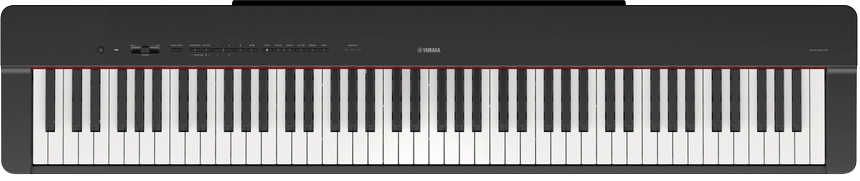
The Yamaha P-225, Roland FP-30X and Kawai ES120 are three of the most-compared compact 88-key digital pianos. We have not played these pianos ourselves, so this is not a hands-on review. Instead, it lines up the official specifications from Yamaha, Roland and Kawai side by side and explains what each difference actually means when you are choosing.
Specs Side by Side
| Spec | Yamaha P-225 | Roland FP-30X | Kawai ES120 |
|---|---|---|---|
| Key action | GHC (Graded Hammer Compact), matte black keytops | PHA-4 Standard, escapement, ivory feel | Responsive Hammer Compact, grade-weighted, matte |
| Piano sound | Yamaha CFX sample, VRM Lite | SuperNATURAL Piano | Harmonic Imaging, SK-EX / EX 88-key sampling |
| Max polyphony | 192 | 256 | 192 |
| Amplifier | 7 W × 2 | 11 W × 2 | 10 W × 2 |
| Speakers | (12 × 8 cm oval + 5 cm) × 2 | 12 cm × 2 | 12 cm × 2 |
| Weight | 11.5 kg (25 lb 6 oz) | 14.8 kg (32 lb 11 oz) with music rest | 12 kg (26.5 lb); 12.5 kg with music rest |
| Width | 1,326 mm | 1,300 mm | 1,305 mm |
| Bluetooth | Audio (varies by country) | Audio + MIDI | MIDI + audio (varies by market) |
| Line outputs | AUX OUT L/L+R, R | Output L/Mono, R (1/4") | Line Out L/Mono, R (1/4") |
| Pedal included | Footswitch (on/off) | DP-2 pedal switch (on/off) | F-1SP switch damper (on/off) |
| Headphone jacks | 2 × standard stereo | 2 (mini + 1/4") | 2 (1/4" + 1/8") |
| USB | USB to Host, USB audio interface | USB-B (MIDI/audio) + USB-A memory | USB-MIDI to Host |
| Voices | 24 | 56 on panel (321 via app) | 25 |
| Price | Check current price | Check current price | Check current price |
Sources: manufacturer spec pages for the Yamaha P-225 (usa.yamaha.com), the Roland FP-30X (roland.com) and the Kawai ES120 (kawai-global.com), plus Kawai UK's ES120 product page for the included F-1SP pedal, checked 11 November 2026. Bluetooth features can differ by country, so confirm the listing for your region.
Still not sure which of the three fits you? Answer 3 quick questions and get a personalized digital piano match for your level, space and budget.
What the Differences Mean
Key action
All three are 88-key graded hammer actions, heavier in the bass and lighter in the treble, but the makers name and describe them differently. Yamaha lists the P-225 as a GHC (Graded Hammer Compact) keyboard with matte black keytops. Roland lists the FP-30X as a PHA-4 Standard keyboard with escapement and ivory feel. Kawai lists the ES120 as a Responsive Hammer Compact action with grade-weighted hammers and matte key surfaces. Feel is personal, so if you can, try the keys in a store before deciding.
Polyphony
Polyphony is how many notes can sound at once. 192 notes (P-225, ES120) is plenty for most home playing; the FP-30X's 256 adds headroom for heavy sustain-pedal use and layered sounds.
Considering Yamaha's entry-level P-145 instead? Our Yamaha P-145 vs P-225 comparison shows what the P-225 adds over it (64 vs 192 notes, CFX, AUX OUT), and our Yamaha P-145 sustain pedal guide covers the footswitch in its box and when a half-pedal FC3A is worth adding.
Speakers
On paper the FP-30X (11 W × 2) and ES120 (10 W × 2) have more amplifier power than the P-225 (7 W × 2). Watts alone don't decide how a piano sounds in your room, but if you plan to play through the built-in speakers rather than headphones, it is a fair tie-breaker.
Weight and portability
The P-225 is the lightest at 11.5 kg, the ES120 is close at 12 kg, and the FP-30X is the heaviest at 14.8 kg with music rest. If you will carry it to rehearsals often, those kilos add up.
Bluetooth and apps
The FP-30X lists both Bluetooth audio and MIDI, and the ES120 lists both too (market-dependent). The P-225 lists Bluetooth audio only, varying by country, with MIDI via USB or Yamaha's optional UD-BT01 adaptor. If you want wireless piano-learning apps, check this row carefully.
Line outputs
All three have stereo line outputs for an amp or PA: AUX OUT (L/L+R, R) on the P-225, 1/4-inch Output (L/Mono, R) on the FP-30X, and 1/4-inch Line Out (L/Mono, R) on the ES120. The ES120 also lists a speakers on/off function for when you are using the Line Out jacks.
Included pedal
All three ship with a basic on/off switch pedal, not a half-pedal unit: a footswitch with the P-225, a DP-2 pedal switch with the FP-30X, and an F-1SP switch damper with the ES120. If you want half-pedaling, that is an optional accessory on each model — Yamaha's FC3A or LP-1, Roland's DP-10 or the KPD-70 three-pedal unit, and Kawai's F-10H, GFP-3 or F-351.
Who Each Piano Is For
Yamaha P-225
Best fit if you want the lightest, slimmest option and a simple Yamaha workflow, and you mostly play at home or through headphones.
Roland FP-30X
Best fit if you want the most polyphony and on-paper speaker power, plus Bluetooth MIDI for learning apps, and you don't mind extra weight.
Kawai ES120
Best fit if you want a light body with dedicated stereo line outs for gigs, Shigeru Kawai SK-EX sampling and Bluetooth MIDI and audio.
Still not sure which of the three matches how you play? Our digital piano finder quiz asks about your level, space and budget and suggests models that fit.
Which Should You Pick?
Use the official specs as a shortlist, then check current prices and, if you can, try the keys in a store. We have not played these pianos ourselves, so this guidance follows the spec sheets rather than a hands-on test.
- Yamaha P-225 if you want the lightest body (11.5 kg) and a simple Yamaha setup for home or headphone practice. You get AUX OUT and a USB audio interface, but Bluetooth is audio only (and varies by country) and the listed amplifier power is the lowest of the three (7 W × 2).
- Roland FP-30X if you want the most polyphony (256), the most listed speaker power (11 W × 2), and built-in Bluetooth audio and MIDI. It is also the heaviest of the three (14.8 kg with music rest).
- Kawai ES120 if you want Shigeru Kawai SK-EX and Kawai EX sampling in a light 12 kg body, dedicated 1/4-inch Line Out jacks, and Bluetooth MIDI and audio (availability can depend on the market).
- All three include only a basic on/off switch pedal. Budget for an optional half-pedal unit if that matters to you.
If your budget, space or playing goals don't map cleanly onto one of these three, get a personalized digital piano recommendation from our AI finder.
Bottom Line
On the spec sheets, the P-225 wins on weight, the FP-30X on polyphony and speaker power, and the ES120 balances low weight with strong connectivity.
None of them is the "best" for everyone. Pick the row in the table that matters most to you, check current prices, and if you want a second opinion, describe your needs to our AI piano finder and get a recommendation in about a minute.
Not Sure Which of the Three Is Right for You?
Answer a few quick questions and get a personalized recommendation based on your budget and playing goals.
FAQ
Which has the most polyphony: P-225, FP-30X or ES120?
Per the manufacturers' spec sheets, the Roland FP-30X has 256-note polyphony; the Yamaha P-225 and Kawai ES120 both have 192.
Which of the three is the lightest?
The Yamaha P-225 is listed at 11.5 kg, the Kawai ES120 at 12 kg (12.5 kg with music rest) and the Roland FP-30X at 14.8 kg with music rest.
Do all three have Bluetooth?
The FP-30X lists Bluetooth audio and MIDI. The ES120 lists Bluetooth MIDI and audio, with availability depending on market. The P-225 lists Bluetooth audio only, and it varies by country; Yamaha sells a separate UD-BT01 wireless MIDI adaptor.
Do they have line outputs for an amp or PA?
Yes. The P-225 has AUX OUT (L/L+R, R), the FP-30X has Output (L/Mono, R) 1/4-inch jacks, and the ES120 has 1/4-inch Line Out (L/Mono, R) jacks.
Do the P-225, FP-30X and ES120 include a sustain pedal?
Yes. All three ship with a basic on/off switch pedal: a footswitch with the Yamaha P-225, a DP-2 pedal switch with the Roland FP-30X, and an F-1SP switch damper with the Kawai ES120. Half-pedaling requires an optional pedal (Yamaha FC3A or LP-1, Roland DP-10 or KPD-70, Kawai F-10H, GFP-3 or F-351).
FindKeyboard.com is an AI-powered keyboard recommendation tool. This article contains affiliate links — we may earn a commission when you purchase through our links, at no extra cost to you. As an Amazon Associate I earn from qualifying purchases.