Yamaha P-145 vs P-225: Is the Upgrade Worth It? Specs Compared
By FindKeyboard.com · Updated 2026-11-01
The Yamaha P-145 and P-225 are the two current compact 88-key P-series digital pianos, and they look almost identical. Both use the same GHC (Graded Hammer Compact) weighted keyboard, so the upgrade is not about key feel. What the P-225 adds is a better piano sample (Yamaha CFX with VRM Lite), three times the polyphony, more voices, onboard recording, a second headphone jack and proper line outputs.
Short answer: a beginner who mostly practises at home on headphones loses little with the P-145. Pay for the P-225 if you will play pedal-heavy or layered music, record yourself, share the piano with a teacher, or plug into an amp or PA.

Yamaha P-145
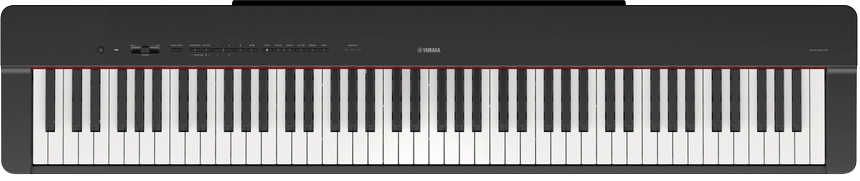
Yamaha P-225
Quick Comparison
| Feature | Yamaha P-145 | Yamaha P-225 |
|---|---|---|
| Keys / action | 88, GHC (Graded Hammer Compact) | 88, GHC (same action) |
| Touch sensitivity | Hard / Medium / Soft / Fixed | Hard / Medium / Soft / Fixed |
| Piano sample | Yamaha CFIIIS | Yamaha CFX |
| Resonance | Damper resonance | VRM Lite + key-off samples |
| Polyphony | 64 notes | 192 notes |
| Voices | 10 | 24 |
| Modes | Dual, Duo | Dual, Duo, Split |
| Rhythms | None (metronome only) | 20 |
| Onboard recorder | No | 1 song, 2 tracks (MIDI) |
| Preset songs | 10 demos + 10 piano songs | 21 demos + 50 classics |
| Amplifiers | 7 W × 2 | 7 W × 2 |
| Speakers | Oval 12 × 8 cm × 2 | (Oval 12 × 8 cm + 5 cm) × 2 |
| Bluetooth | None (P-145BT adds Bluetooth audio) | Audio only (varies by country) |
| USB to Host | MIDI + audio (16-bit) | MIDI + audio (24-bit) |
| Headphone jacks | 1 × 1/4" | 2 × 1/4" |
| Line out | No AUX OUT | AUX OUT [L/L+R] [R] |
| Weight | 11.1 kg (24 lb 8 oz) | 11.5 kg (25 lb 6 oz) |
| Size (W × D × H) | 1,326 × 268 × 129 mm | 1,326 × 272 × 129 mm |
| Matching stand / 3-pedal unit | L-100 / LP-5A | L-200 / LP-1 |
| In the box | Music rest, footswitch, AC adaptor* | Music rest, footswitch, AC adaptor* |
| Price | Check current price | Check current price |
*Yamaha notes that the included AC adaptor varies by area. Specs are from Yamaha's official P-145, P-145BT and P-225 spec pages.
Still not sure which one fits you? Answer 3 quick questions in our digital piano finder quiz and get a personalized recommendation.
What Is the Same on Both
Yamaha lists the same keyboard on both models: 88 keys, GHC action with matte black keytops, and the same four touch settings. Yamaha says GHC was built to give the same weighted, acoustic-piano-like feel as the GHS action in older P-series models, in a shorter, slimmer body. So if key feel is your main reason to spend more, the P-225 will not change it. If feel matters most, compare a different action instead, for example in our Yamaha P-145 vs Roland FP-10 comparison.
Both also share the same width (1,326 mm), the same 7 W × 2 amplifiers, USB to Host with MIDI and audio, Smart Pianist app support, and a footswitch in the box. The footswitch in the box is on/off only on both. For half-pedaling, Yamaha lists the separately sold FC3A pedal (and the LP-5A unit on the P-145); the P-225 lists half-damper pedal control.
Sound
Yamaha P-145: AWM stereo sampling of the Yamaha CFIIIS concert grand, with damper resonance, and 10 voices (including electric pianos, organs, strings, harpsichord, accordion and Di Zi, per Yamaha).
Yamaha P-225: a sample of Yamaha's flagship CFX concert grand, plus key-off samples and Virtual Resonance Modeling (VRM) Lite, which Yamaha describes as recreating the string resonance of a grand piano in real time as you play and pedal. It has 24 voices and adds Intelligent Acoustic Control (IAC), which adjusts the tone to the overall volume, Stereophonic Optimizer for headphones, and a Wall EQ setting.
On the speaker side, both run 7 W × 2, but the P-225 adds a 5 cm speaker on each side of its oval speakers. We have not compared these two pianos side by side ourselves, so listen to Yamaha's official demos of both through the same headphones before you decide.
Polyphony
P-145: 64 notes. P-225: 192 notes. Polyphony is how many notes the piano can sound at once. Held notes, notes ringing under the sustain pedal, and layered voices (Dual mode) all count. 64 is usually enough for beginner pieces, but sustain-heavy music and layered sounds use it up faster, and that is when older notes can cut off early. 192 gives far more headroom.
Practice and Performance Features
The P-145 is deliberately simple: Yamaha calls it the entry-level P-series model "equipped with only the essential tones and functions". It has Dual and Duo modes and a metronome, but no recorder and no rhythms.
The P-225 adds Split mode (for example, bass in the left hand and piano in the right), 20 rhythms to play along with instead of a plain click, and a 2-track MIDI recorder for one song, so you can record a left-hand part and play the right hand over it, or listen back to your practice.
Connectivity
Yamaha P-145
- ✓ USB to Host (MIDI + audio, 16-bit)
- ✓ 1 headphone jack (1/4"), also used as the output
- ✓ Sustain pedal input + pedal unit jack
- ✗ No AUX OUT
- ✗ No Bluetooth (P-145BT adds Bluetooth audio)
Yamaha P-225
- ✓ USB to Host (MIDI + audio, 24-bit)
- ✓ 2 headphone jacks (1/4")
- ✓ Sustain pedal input + pedal unit jack
- ✓ AUX OUT [L/L+R] [R]
- ✓ Bluetooth audio (varies by country)
Line out is the practical difference. According to Yamaha's own FAQ, the P-145 connects to external speakers through its headphone/output jack, so its built-in speakers go silent while it is connected. The P-225 uses dedicated AUX OUT jacks, so its own speakers keep playing. For a church, a school hall or a small gig, that matters.
Bluetooth is audio only on both. The P-225 (in most countries) and the P-145BT can stream music from your phone through the piano's speakers. Neither has built-in Bluetooth MIDI. Learning apps connect over USB, or wirelessly with Yamaha's separately sold UD-BT01 wireless MIDI adaptor.
P-145BT vs P-225
In some markets, including the US, Yamaha's current lineup lists the P-145BT rather than the plain P-145. It is the same piano (CFIIIS sample, 64 notes, 10 voices, same GHC keys, 11.1 kg) with Bluetooth audio added. That removes the P-225's Bluetooth advantage, but everything else above still applies: the P-225 keeps the CFX sample with VRM Lite, 192-note polyphony, 24 voices, Split, rhythms, the recorder, two headphone jacks and AUX OUT.
Who Should Buy the Yamaha P-145?
If you already own one, the sustain pedal for the Yamaha P-145 guide explains when the footswitch in the box is enough.
- →You are a beginner and want 88 weighted Yamaha keys for the least money
- →You mostly practise at home, often on headphones
- →You want piano first and do not need rhythms, Split or a recorder
- →You will never plug into an amp or PA
On Amazon US this is listed as the P-145BT (P-145 with Bluetooth audio).
Who Should Buy the Yamaha P-225?
For how the P-225 stacks up against its main rivals, see our Yamaha P-225 vs Roland FP-30X vs Kawai ES120 comparison.
- →You play (or plan to play) pedal-heavy pieces or layered sounds
- →You want Yamaha's CFX sample and VRM Lite resonance
- →You need AUX OUT for an amp, PA, church or school hall
- →Two people will listen on headphones (teacher and student)
- →You want to record practice on the piano or play along with rhythms
The Verdict
Same keys, same size, different insides. Buy the P-145 (or P-145BT) if you are starting out, practise at home and want to keep the budget for a stand, bench and a better pedal. Buy the P-225 if you will use the extra polyphony, the CFX sound, the recorder, or the AUX OUT. Check the current price gap first: the further apart they are, the more the P-145 makes sense for a pure beginner.
Not sure a compact Yamaha is right at all? Our digital piano finder compares across brands for your budget, space and goals. Still deciding on key count? Beginners who want to learn piano should buy 88 weighted keys.
Frequently Asked Questions
Do the P-145 and P-225 have the same action?
Yes. Yamaha lists both with the GHC (Graded Hammer Compact) keyboard with matte black keytops and the same Hard/Medium/Soft/Fixed touch settings.
Is the Yamaha P-225 worth it over the P-145?
It is worth it if you will use what it adds: the CFX sample with VRM Lite, 192-note polyphony, 24 voices, Split, rhythms, the recorder, two headphone jacks and AUX OUT. It is not worth it for better key feel, because the action is the same.
What is the difference between the P-145BT and the P-225?
The P-145BT is a P-145 with Bluetooth audio, so both stream music from a phone. The P-225 still adds the CFX sample, VRM Lite, 192-note polyphony (vs 64), 24 voices (vs 10), Split, 20 rhythms, a 2-track recorder, a second headphone jack and AUX OUT.
Does the P-145 support half-pedaling?
Yes, with an optional pedal. Yamaha says the FC3A foot pedal and the LP-5A three-pedal unit both support half-pedaling on the P-145. The footswitch in the box is on/off only. Yamaha also lists half-damper pedal control for the P-225, with the FC3A sold separately.
Do the P-145 or P-225 have Bluetooth MIDI?
No. The P-225 (varies by country) and the P-145BT have Bluetooth audio only. For learning apps, use USB to Host or Yamaha's separately sold UD-BT01 wireless MIDI adaptor.
Which is better for gigging or church?
The P-225. It has AUX OUT jacks and keeps its own speakers on while connected. The P-145 sends sound out through its headphone jack, which silences its speakers. See also our best digital piano for church guide.
How We Compared
We have not played these two pianos side by side ourselves. Every spec on this page comes from Yamaha: the P-145 spec page, the P-145BT spec page, the P-225 spec page, and Yamaha's P-145 vs P-225 FAQ (Japanese). Features marked "varies by country" or "varies by area" are Yamaha's wording, so check the listing for your region before you buy.
Not sure which is right for you?
FindKeyboard asks you a few questions and gives you a personalized recommendation in seconds.
Find My Keyboard →This post contains affiliate links. If you purchase through our links, we may earn a small commission at no extra cost to you. As an Amazon Associate I earn from qualifying purchases.