Best Digital Piano for Beginners 2026: P-145
By FindKeyboard.com · Updated August 2026 · 8 min read

If you want to learn piano, do not buy a 61-key toy keyboard. You want an 88-key digital piano with weighted keys. That is the whole decision. Everything else (extra voices, lights, "600 sounds") is noise.
Google is full of "best keyboard for beginners" roundups that mix PC mechanical keyboards with $99 Casio minis. This page is only about instruments you sit down at and practice on.
Quick pick: buy the Yamaha P-145 unless you care more about key feel than brand (then the Roland FP-10) or you are extremely tight on desk space (then the Casio PX-S1100).
The old default, the Yamaha P-45, is discontinued. It still shows up in leftover stock. Skip it unless it is meaningfully cheaper than a new P-145.
What a beginner actually needs
88 keys
If the goal is piano (lessons, classical, pop with two hands, a real acoustic later), start at 88. A 61-key portable is fine for kids messing around or for synth/organ parts. It is not a piano. More on sizes in our 61 vs 76 vs 88 keys guide.
Weighted keys
Unweighted keys feel like buttons. They do not build finger strength or dynamics. If you ever sit at an acoustic, you will have to relearn touch. Graded hammer action (heavier in the bass, lighter in the treble) is the minimum.
Built-in speakers
You will practice without headphones some of the time. The P-145, FP-10, and PX-S1100 all have speakers. (Some older roundups, including an earlier version of this page, claimed the P-45 and FP-10 had none. That was wrong.)
A stand, a bench, and a pedal
Slab pianos ship as a keyboard in a box. Budget ~$140 extra. We cover the four pieces in digital piano accessories.
Budget
Serious beginner: $400–$600. Under $250 usually means unweighted 61 keys. Over $800 is nicer, not required for year one.
Best digital pianos for beginners in 2026
Yamaha P-145
This is the replacement for the P-45, and it is the one to buy new. Same 88-key graded hammer idea, quieter action, better piano sample, and USB audio so you can record into a laptop without a separate interface. Yamaha's Smart Pianist app is usable here. The P-45 could not do that cleanly.
The box already includes an on/off footswitch; see the sustain pedal for the Yamaha P-145 if you are deciding whether to keep it.
Buy this if
You are starting lessons, you want the safe Yamaha choice, and you do not want to think about it.
Skip it if
You try it next to an FP-10 and the Roland keys feel obviously better in your hands. That happens. Trust the feel.
What about the P-45?
Discontinued. The ASIN is still floating around as leftover stock. Only worth it if you find it at least $80 cheaper than a P-145, and you accept older speakers, no USB audio, and no path to the current Yamaha app features.
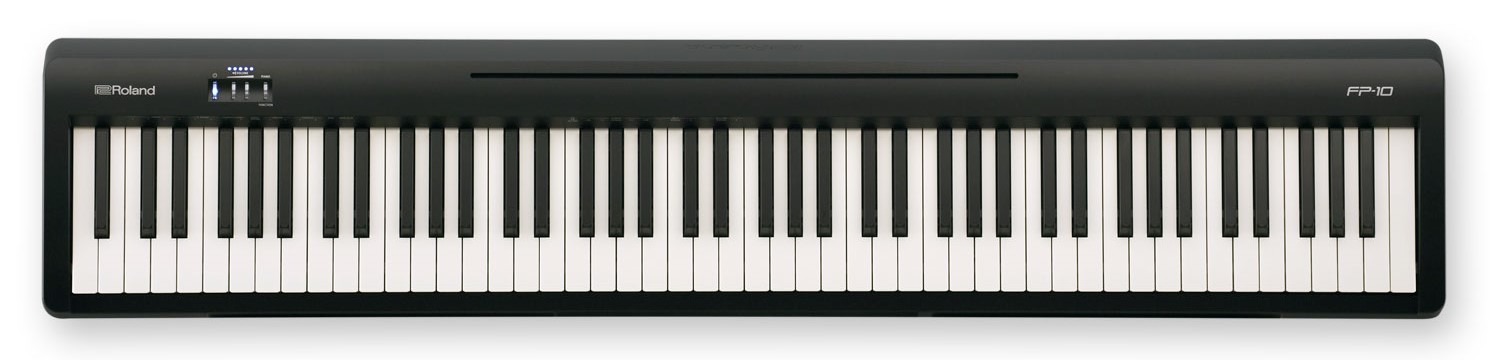
Roland FP-10
If you play slowly, classically, or you just care how the key releases, the FP-10 wins this price band. PHA-4 with escapement is the reason people pay Roland money. Bluetooth MIDI is also the least annoying way to use Simply Piano or Flowkey without a USB dongle.
Polyphony is 96 vs 64 on old P-45-class Yamahas, so heavy pedal work is less likely to drop notes.
Buy this if
Feel matters more than the Yamaha badge, or you will practice with a phone app.
Skip it if
You want Yamaha's warmer, simpler "turn it on and play piano" vibe, or you find the P-145 on a real sale.
Our older P-45 vs FP-10 comparison still explains the feel difference. Treat the P-45 side as "why Roland won that matchup," then buy a P-145 or FP-10, not a P-45.

Casio PX-S1100
This is the one you can actually leave out in a small apartment. Depth is the win. Bluetooth audio is useful for backing tracks. The action is good, not as convincing as the FP-10, not as "standard issue" as Yamaha GHC.
Buy this if
The instrument has to live on a shallow desk, or you move it weekly.
Skip it if
You can spare the depth for a P-145 or FP-10. Give the extra centimeter to the better action.
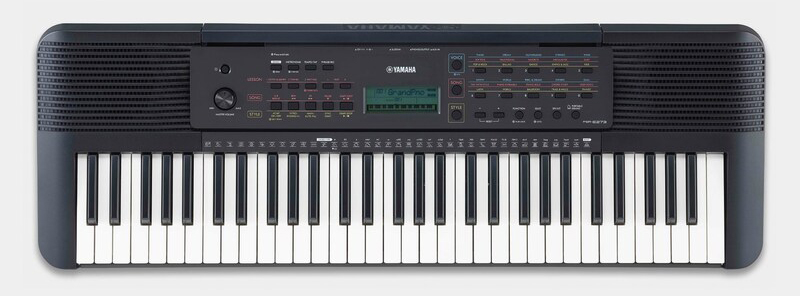
A 61-key keyboard — Yamaha PSR-E273
If this is for a young kid, a casual "I want sounds and rhythms," or you already know you will not practice two-handed piano, a portable 61-key is cheaper and lighter. Yamaha's PSR-E273 is the honest budget version.
Do not tell yourself you will "upgrade later" if the real goal is piano. You will practice the wrong touch for a year. Spend the extra on 88 weighted keys once.
Quick comparison
| Model | Keys | Action | Speakers | Bluetooth | Approx. | Buy |
|---|---|---|---|---|---|---|
| Yamaha P-145 | 88 | GHC weighted | Yes | App / USB audio | $500–$580 | Amazon |
| Roland FP-10 | 88 | PHA-4 + escapement | Yes | MIDI | $500 | Amazon |
| Casio PX-S1100 | 88 | Smart Scaled Hammer | Yes | Audio + MIDI | $500 | Amazon |
| Yamaha PSR-E273 | 61 | Unweighted | Yes | No | ~$180 | Amazon |
| Yamaha P-45 (used / leftover) | 88 | GHS | Yes (2×6W) | No | ~$400 if you find it | Amazon |
Prices move. Use the Amazon button for the live number. A footswitch is already in the box, so add a stand and bench — see the accessories guide.
How to choose in 30 seconds
Still torn? The quiz on the homepage will pick one of these. Do not start there if you already know you want 88 weighted keys. You already know. Click the Amazon link.
Common mistakes
Buying unweighted keys "just to start."
You are training the wrong muscles. The cheap 61-key becomes a $180 delay.
Paying for 600 voices.
You will use the grand piano, maybe an electric piano. Action and the main piano sound matter. Feature count does not.
Buying a pedal you already own.
Most repertoire assumes a sustain pedal, and the P-145 ships with an on/off footswitch. Keep it — see the P-145 pedal guide before you buy a second one.
Shopping the word "keyboard."
That word, in 2026 search results, is mostly PC gaming boards. Search digital piano. That is what this page is.
Not sure which of the three 88-key slabs fits your room?
Answer a few quick questions and get a personalized recommendation based on your budget and space. Free, no signup required.
Find My Keyboard →FAQ
What is the best digital piano for beginners in 2026?
The Yamaha P-145 for most people. The Roland FP-10 if key feel is the priority. Both are 88-key weighted instruments around $500.
Do beginners need 88 weighted keys?
Yes, if the goal is piano. 61 unweighted keys are for casual playing, kids, or electronic music. You can start on 61. You will outgrow it if lessons stick.
Does the Yamaha P-145 have speakers?
Yes. So do the FP-10 and the PX-S1100. You can practice without headphones. Headphones are still worth buying for nights and shared walls.
Is the Yamaha P-45 still good?
It is a fine used/leftover piano. It is not the 2026 recommendation. Prefer the P-145 unless the P-45 is clearly cheaper.
Can I learn piano on a cheap keyboard?
Basics, yes. Technique, no. Cheap unweighted keys do not transfer to an acoustic. If you will take lessons for more than a few months, buy weighted 88s now.
Not sure which of the three 88-key slabs fits your room? Find a keyboard in a few questions, or just get the P-145 and start practicing.
FindKeyboard.com is an AI-powered keyboard recommendation tool. This article contains affiliate links — we may earn a commission when you purchase through our links, at no extra cost to you.